Welcome to Business Structuring 101! This article is a crash course in the basics of structuring a New Zealand Business and is a written form of the above video. Firstly we'll discuss the differences between operating as a sole trader versus formally registering a company, then we'll move into shareholding, and finally we'll highlight how trusts complete the picture in an idealised scenario.
Sole Trader Vs. Company
For most people, there are really only two types of structuring to consider, do you want to formally register as a company, or do you want to be a sole trader?
Being a sole trader means that you and your business are the same legal entity. If the business gets into hot water, it means you're in hot water. If you rack up a bunch of debt with somebody, most commonly Inland Revenue, then they can come after your personal assets.
Registering a company means that you and your business are separate legal entities. So, if the business can't pay its debts, then the people the business owes money to have options like liquidating the business to get its money out, but they can't come after your personal assets, like your family home.
That doesn't give you the freedom to recklessly load up on debt, then say "haha, tough luck" to your creditors though. As a director of the company, you have a bunch of duties that you need to comply with. The duties are all fairly common sense stuff, like don't do anything that is likely to create a serious loss to a creditor, make all your company filings on time, act in good faith etc. but if you breach these duties, then it doesn't matter that it's a limited liability company, your personal assets could be at risk.
How Many Shares Should My Company Have?
Choosing to operate as a sole trader or a company is the first level of structuring. The next level involves how that company is owned.
Trusts, Tax Planning, and Asset Protection
Choosing to operate as a sole trader or a company is the first level of structuring. The next level involves trusts.
Trusts are another entity that's separate from you. They used to be a super popular tax planning vehicle. However, from 1 April 2024 the trust's tax rate was realigned to match the individual top tax rate at 39%, which cut down on a lot of the tax planning opportunities. Combine that with an update to the Trusts Act 2019 which made being a trustee more onerous and the result is that fewer people are able to benefit from a trust.
However, there are still some tax planning opportunities involving trusts that typically happen when one person in a relationship earns more than the other, or there are adult children who are beneficiaries, but they're more case by case and the cost versus benefit isn't always there.
But from an asset protection point of view, trusts still do have a role to play. Having the family home in a trust is a great way to make sure that if anybody were to come after your personal assets that the family home is tucked away inside a trust.
The "Gold Standard" Structure
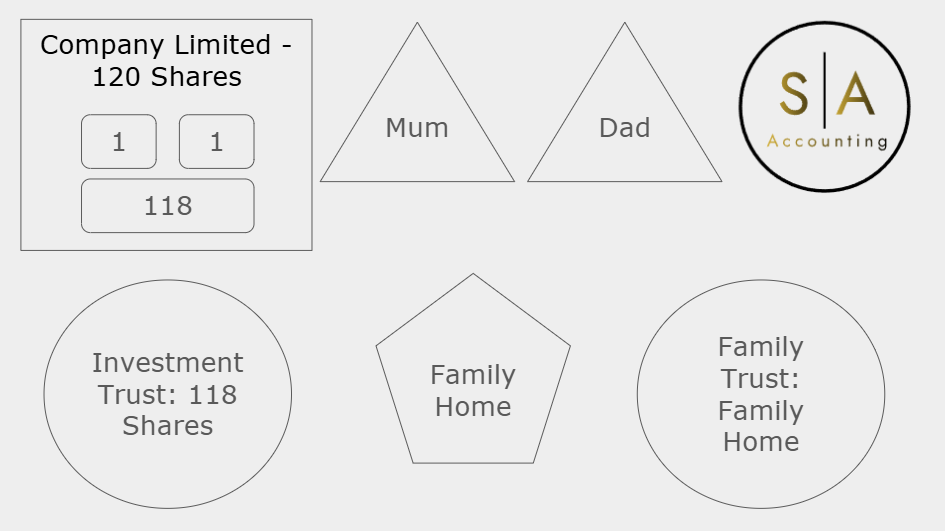
The "best" way depends on your situation, but the 'gold standard' way of structuring a typical mum and dad owned Kiwi business is to register a limited liability company with 120 shares, mum and dad each own 1 share each, with the remaining 118 shares owned by the family investment trust. The family home, and any other significant personal assets are often transferred to a second family trust.
Disclaimer: This is not legal advice, there are all sorts of exceptions and specific circumstances that might make this structure inappropriate for you. While this is the most commonly advised structure, it's not always the most cost effective option.
If you'd like answers to your structuring questions, then send us an email [email protected].
Based in Dunedin, New Zealand, we offer free online consultations no matter where you're based. Take you first Step to get Ahead and click here to get a free instant estimate.
What is the main difference between a Sole Trader and a Company?
Liability. If you are a sole trader, your personal assets (like your house or car) are at risk if the business cannot pay its debts. If you register a company, the business is a separate legal entity, meaning your personal assets are generally protected from business creditors, provided you haven't breached director duties.
Why do people use Trusts for business structuring?
While the tax benefits of trusts have decreased with the new 39% trustee tax rate, they are still excellent for asset protection. Placing your family home or other valuable assets into a trust can protect them from creditors in the event your business fails.